


Arc Flash Hazard Reports: A Critical Part of Electrical Safety and OSHA Readiness
Electrical systems are the backbone of most facilities, but they can also create one of the most severe hazards in the workplace: an arc flash. An arc flash can release intense heat, pressure, light, molten metal, and sound in a fraction of a second. The consequences can include serious burns, permanent injury, equipment damage, unplanned downtime, and potential regulatory exposure.
An arc flash hazard report is not simply a set of equipment labels. It is a practical safety tool that helps your organization understand electrical risk, make informed decisions, and protect the people who operate and maintain your facility.
What an Arc Flash Hazard Report Provides
An arc flash hazard report is developed from a detailed evaluation of a facility’s electrical distribution system. Depending on the scope, it typically includes a field data collection effort, an up to date one-line diagram, short-circuit and protective-device coordination studies, an arc-flash risk assessment, equipment labels, and recommendations for improving protection and coordination.
The resulting information helps identify the prospective incident energy at electrical equipment, the arc flash boundary, and the equipment or personal protective equipment (PPE) requirements for qualified personnel. It gives your safety program a usable basis for safer planning and work practices.
How OSHA Applies
OSHA’s electrical-safety requirements do not generally require every employer to purchase a document titled “Arc Flash Hazard Report.” However, OSHA standards establish requirements for protecting employees from electrical hazards, including safe work practices, training, de-energization and lockout/tagout, and appropriate PPE. An arc flash hazard report can help support these efforts, but the report alone does not establish OSHA compliance. Applicable requirements depend on the work and circumstances.
NFPA 70E, Standard for Electrical Safety in the Workplace, provides a widely used framework for electrical safety practices. An arc flash hazard report and the information it produces can support an electrical safety program; they do not, by themselves, demonstrate compliance with every applicable OSHA requirement.
In practical terms, a current arc flash hazard report supports key employer responsibilities:
- Identifying electrical hazards before work begins
- Prioritizing de-energization and establishing electrically safe work conditions
- Selecting arc-rated clothing and PPE when energized work is absolutely required and permitted under applicable safety procedures
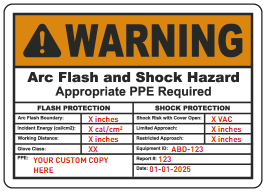
- Providing durable field labels and accurate information to inform qualified workers of the hazards present
- Training personnel on the risks and controls applicable to their work involving electrical hazards
- Documenting a deliberate, repeatable approach to electrical safety
Why the Five-Year Review Matters
NFPA 70E calls for arc flash risk assessments to be reviewed at intervals not exceeding five years. They must also be updated when changes to the electrical distribution system could affect the assessment results.
That distinction matters. Five years is the maximum routine review interval, not a reason to wait when your system has changed. New service equipment, transformers, generators, utility changes, new motors or process loads, altered protective-device settings, breaker replacements, or changes in available fault current can all affect arc flash incident energy and label accuracy.
Outdated labels can lead personnel to use PPE that is not appropriate for the current actual hazards. They can also undermine coordination, maintenance planning, and the credibility of the facility’s electrical safety program. A scheduled review helps ensure the report remains an active safety resource rather than a historical record.
The Role of the Report in a Strong Safety Program
The report is a starting point, not a substitute for safe work practices. It should work alongside an established electrical safety program that includes qualified-person training, lockout/tagout procedures, applicable work procedures, and equipment maintenance.
When properly integrated, the report helps teams plan work before they open equipment, prioritize establishing an electrically safe work condition, and identify protective measures when energized work is absolutely required and permitted under applicable safety procedures. It can also help identify where engineering improvements may reduce risk and where corrective actions should be prioritized.
Potential Consequences of Inadequate Electrical Safety Controls
The most important consequence is human: a preventable arc flash event can change a worker’s life permanently. Beyond injury risk, employers may face equipment damage, production interruptions, repair costs, higher insurance costs, and reputational harm.
Regulatory consequences can be significant as well. Following an inspection or incident, OSHA may cite an employer for violations related to electrical safe work practices, PPE, training, hazard assessment, or failure to control recognized hazards. Citations may be classified as serious, other-than-serious, willful, repeated, or failure-to-abate, depending on the facts. Civil penalties are adjusted periodically for inflation, and willful or repeated violations can carry substantially higher penalties. In severe cases, OSHA enforcement may be accompanied by other legal, contractual, or insurance consequences.
No report can guarantee compliance or eliminate all risk. But a current, site-specific arc flash hazard report, paired with a well-implemented electrical safety program, demonstrates that your organization has taken meaningful steps to identify hazards and protect its employees and those providing services on their equipment.
How We Can Help
Our team helps facilities turn complex electrical-system data into actionable safety information. We provide arc flash hazard reports and assessments tailored to your facility, including data collection, engineering analysis, updated one-line diagrams, coordination review, equipment labeling, and clear recommendations for reducing risk.
If your report is approaching five years old, or if your electrical system has changed since the last report, now is the right time to review it. If you do not have an arc flash report for your electrical system, now is the time to initiate one. For more information, please contact Practice Area Leader, Eric Horvat, in B&L’s Facilities department.
This article is provided for general informational purposes and is not legal advice. Applicable OSHA requirements and state-plan enforcement may vary by jurisdiction and circumstance. Consult qualified safety, legal, and electrical professionals for site-specific guidance.
References:
OSHA, Electric-Arc Flash Hazards <https://www.osha.gov/electrical/flash-hazards>
OSHA, 29 CFR 1910.333—Selection and Use of Work Practices <https://www.osha.gov/laws-regs/regulations/standardnumber/1910/1910.333>
NFPA, NFPA 70E: Standard for Electrical Safety in the Workplace <https://www.nfpa.org/education-and-research/electrical/learn-more-about-nfpa-70e>
OSHA, Penalties <https://www.osha.gov/penalties/>